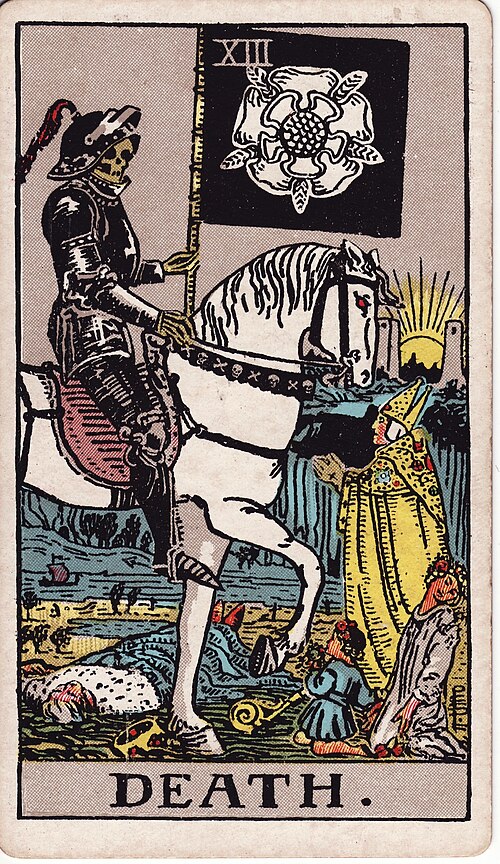
Death Tarot Card Meaning
Death is card XIII of the Major Arcana, and it is almost never about literal death. It is the tarot's card of necessary endings: the job, belief, habit, or chapter that has run its course and has to go before anything new can grow. It can be unsettling to see, but it tends to arrive when something has already finished and you are deciding how to let it.
- Upright
- endings, transformation, transition
- Yes or no
- Maybe
- Number
- XIII
What Death shows
A skeleton in black armor rides a white horse across the card, carrying a black banner marked with a white five-petaled rose, a symbol of beauty and purity that outlasts the change. In front of the horse, a king lies fallen with his crown off, a bishop in a tall miter pleads with folded hands, a young woman in white turns her face away, and a child kneels with flowers. Rank, piety, youth, and innocence all meet the same moment, and none can bargain with it.
Behind them the scene is quieter. A river runs toward a small boat, and between two distant towers a pale sun is rising. Death moves through the foreground, but the horizon is already brightening. The card is not cruel, only honest: what is finished is finished, and morning follows.
Death upright
Upright, Death marks a real ending and the transformation that follows it. Something is over, whether a role, a relationship pattern, a living situation, or an old idea of yourself, and the card asks you to stop propping it up. Like the king in the picture, what you held onto so tightly may already have lost its power. The relief often comes only after you accept that.
In daily life this can look like finally resigning from something, ending a long habit, moving on from a friendship that faded, or noticing you have outgrown a goal you used to chase. It is rarely dramatic. More often it is a quiet "I'm done with this," followed by empty space that is uncomfortable at first and then spacious. The transition may take time, so allow it to.
Death reversed
Reversed, Death points to resistance. The ending has arrived, but you are bargaining, delaying, or pretending it hasn't. You might be staying in a job that no longer fits, rereading old messages, or keeping a plan alive because abandoning it feels like failure. Like the pleading bishop, you may be hoping that enough effort will change the outcome.
This often shows up as stagnation: the same argument on repeat, a sense of being stuck, or change that happens in fits and starts without ever being completed. The card is not scolding you. It asks what you are afraid will be lost, and whether holding on is costing more than letting go would. Sometimes it also signals a change that is only half finished and needs a final step.
Death in love
Upright, Death in love suggests a relationship phase, a pattern, or a way of dating is ending, making room for something more honest. For some it is a breakup, and for others it is an old dynamic dissolving inside a lasting bond. Reversed, it suggests clinging to a past partner, a fantasy, or a stale routine out of fear of being alone, or avoiding a conversation that would let a relationship change or end cleanly.
Death in career
Upright, this card points to a work chapter closing: a role ending, a field you've outgrown, or a restructuring of how you spend your days. It supports a clean break and a fresh direction. Reversed, it describes staying put out of habit or fear, resisting new methods, or dragging out a transition. The question is what you would do if you stopped protecting what used to work.
Death and money
Upright, Death asks you to retire a financial habit or attitude that no longer serves you, such as an old spending pattern, a way of avoiding your accounts, or a belief about what you deserve. Reversed, it suggests holding onto familiar money habits or anxieties because they feel safer than change, even when they have stopped working. This is about mindset and choices, not a forecast of any financial result.
Death in a past, present or future position
Every spin of the Wheel of Fate draws three cards: your Past, Present and Future. Here's how Death reads in each place.
As your Past card
In the Past position, Death says an important ending has shaped where you are now. Something was released, by choice or not, and its effects still linger. You may still be processing it, or only now recognizing how much it changed you.
As your Present card
In the Present position, you are in the middle of a transition or being asked to close a chapter. The air may feel emptied out, which is natural. Focus on what is actually finished and stop trying to rescue it.
As your Future card
In the Future position, Death suggests an ending and a renewal may be approaching if you stay open to them. It describes a theme, not a fixed event. Preparing to let go of what has run its course may make the shift easier.
Is Death a yes or no card?
Maybe. Death is a yes to change and a no to staying the same. It rarely answers a plain yes-or-no question directly, because it deals with endings. If your question is about whether something should continue unchanged, the answer leans no. If it is about whether you can move forward, it leans yes.
Advice from Death
Ask yourself what is already over that you are still treating as alive. Name it plainly, perhaps in writing, and decide one small way to honor it and release it. Notice the white rose on the banner and the sun between the towers: letting go is not the same as erasing what mattered. Make room, then see what wants to grow there.
Death FAQ
Does the Death tarot card mean someone will die?
No. In tarot, Death is a symbol of endings and transformation, not a prediction about anyone's life or health. It points to something finishing, such as a job, habit, or relationship phase, so that a new stage can begin.
What does the Death card mean reversed?
Reversed, Death usually means resisting an ending or clinging to something that has run its course. It can describe stagnation, delayed decisions, or fear of change. It invites you to look at what you're holding onto and why.
What does the white rose on the Death card mean?
The white rose on the black banner symbolizes purity, beauty, and renewal that survive change. It suggests that even as old forms fall away, something essential and valuable continues, and the card is not purely about loss.