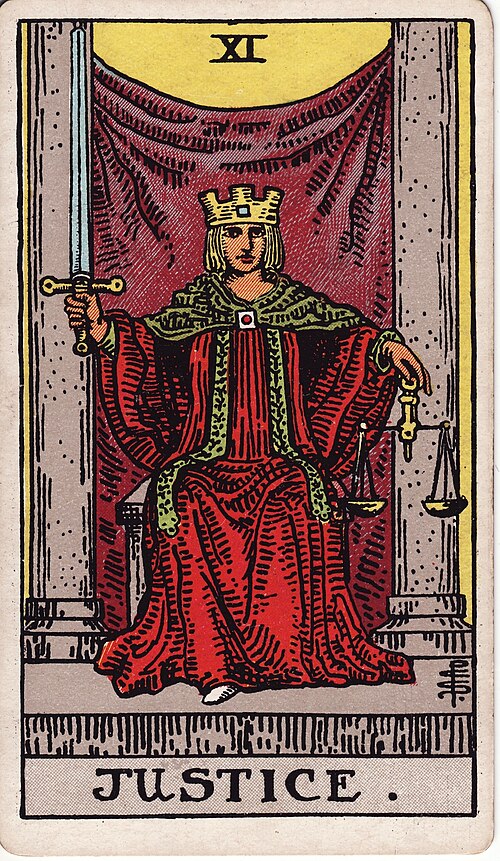
Justice Tarot Card Meaning
Justice is card XI of the Major Arcana, and it asks a plain, uncomfortable question: what is actually true here? It is less about punishment than about accuracy. Actions have consequences, facts matter more than feelings about the facts, and a decision made with clear eyes tends to hold up. When Justice turns up, you are being invited to weigh things honestly, including your own part in them.
- Upright
- fairness, truth, balance
- Yes or no
- Maybe
- Number
- XI
What Justice shows
A crowned figure sits on a stone throne, facing you directly. The pose is symmetrical and still, as if the figure has already listened to everyone and is ready to speak. Two gray pillars rise on either side, and a purple curtain stretches between them. Purple is the color of conscience and deliberation, and the curtain makes the scene feel like a courtroom or a threshold you cannot skip. The yellow sky behind it gives the scene a bright, even light with no shadows to hide in.
The figure's two tools do different jobs. The scales in the left hand weigh what is known: both sides, every detail, nothing rushed. The upright sword in the right hand stands for the decision that follows, and it is double-edged, so a ruling cuts both ways and the person delivering it is not exempt. The red robe suggests the heat of real stakes, held in check by a green cloak. A small square clasp at the throat and a square jewel on the gold crown echo the stable, four-sided logic of the throne. If you look closely, a white shoe peeks out from under the hem, a hint that fairness has to be practiced, not just admired.
Justice upright
Upright, Justice points to fairness, honesty and consequences that fit the cause. It often appears when you are making a decision that deserves careful thought, or when the results of earlier choices are arriving. The card does not promise you will be rewarded or let off the hook. It says the situation is best handled by looking at the evidence, keeping your word and accepting what follows.
In everyday life this can look like a frank conversation where both people finally get to say their piece, a contract or agreement read carefully before you sign, or the relief of admitting a mistake and fixing it. It can also mean being fair to yourself, neither inflating your faults nor excusing them. Justice favors clean books, clear terms and the kind of integrity that does not need an audience.
Justice reversed
Reversed, Justice suggests the scales are tilted. That might be an unfair arrangement, a half-truth, or a story edited to make someone look better than the facts allow. Sometimes the imbalance is outside you, such as a lopsided workload or a rule applied unevenly. Sometimes it is inside: a habit of blaming others, shading the truth, or putting off an honest look at what you did.
Day to day, this can show up as dodging a difficult conversation, making a decision on impulse and then arguing for it afterward, or holding a grudge based on only one side of the story. The reversed card is also a nudge to check your sources. If you feel certain you are in the right, ask what the other person would say, and whether you would accept the same standard if it were applied to you.
Justice in love
Upright, Justice in love favors honesty, mutual respect and relationships where give and take are roughly even. It can mean a conversation that clears the air, or a choice about commitment made with open eyes instead of wishful thinking. For singles, it may encourage you to look at the patterns you keep repeating and what you truly require from a partner. Reversed, it can point to a lopsided dynamic, keeping score, hiding something, or avoiding responsibility for how you have affected someone. It asks whether both people are being treated fairly and whether the story you tell about the relationship matches what actually happens in it.
Justice in career
Upright, Justice in work suggests that clear standards, accurate records and fair dealing are your allies. You may be weighing a decision, preparing for a review, negotiating terms, or being recognized for work that was done properly. Details matter, so read the fine print and document what you agree to. Reversed, it can signal office politics, unclear expectations, credit going to the wrong person, or a temptation to cut corners. It may also ask whether you are avoiding accountability for a mistake. Raising a concern calmly, with facts in hand, usually serves you better than letting resentment build.
Justice and money
Upright, Justice in money matters points to balanced habits: spending that matches your values, honest accounting, and keeping commitments to others. It favors knowing exactly where you stand rather than guessing. It does not predict any particular financial outcome, only that clarity helps. Reversed, it can hint at ignored statements, rationalized purchases, or an unfair arrangement you have been tolerating. It may also reflect a habit of making promises you cannot comfortably keep. The question to ask is whether your choices about money would look fair to someone who knew every detail.
Justice in a past, present or future position
Every spin of the Wheel of Fate draws three cards: your Past, Present and Future. Here's how Justice reads in each place.
As your Past card
In the Past position, Justice suggests that an earlier decision, agreement or honest reckoning still shapes your situation. You may have faced a moment when the truth came out, or you made a choice whose consequences you are still living with. It invites you to look back with fairness instead of blame.
As your Present card
In the Present position, Justice says you are at a point of weighing and deciding. The facts matter right now, so gather them, listen to every side and be honest about your role. A balanced, clear-headed choice is available to you today.
As your Future card
In the Future position, Justice suggests that the path ahead rewards honesty and careful judgment. Choices you make now are likely to have effects that fit their causes, so it helps to act in ways you can stand behind. It points to a theme, not a guaranteed result.
Is Justice a yes or no card?
Maybe. Justice leans toward Maybe because it is a card about weighing facts, not granting wishes. If your plan is honest, fair and well considered, the card is supportive. If it depends on shortcuts or leaving out inconvenient details, expect the scales to tip against it.
Advice from Justice
Before you decide, write down the facts of the situation as if you were reporting them to a neutral stranger, without adjectives or excuses. Then add the other person's likely view, and your own part in what happened. If something needs correcting, such as an apology, a clarification or a boundary, say it plainly and without drama. Justice does not ask you to be harsh. It asks you to be accurate, and to act on what you find.
Justice FAQ
What does the Justice tarot card mean?
Justice represents fairness, truth and cause and effect. In the Rider-Waite-Smith deck, a crowned figure holds scales and an upright sword, symbolizing careful weighing followed by a clear decision. It often appears when honesty, accountability or an important choice is at the center of a situation.
Does the Justice card mean a court case will go my way?
No. Tarot cannot predict legal outcomes, and Justice is not a verdict. It is a card about the principle of fairness and the consequences of choices. In a reading about a dispute, it encourages you to gather facts, be honest and seek qualified professional advice if you need it.
What does Justice reversed mean in tarot?
Reversed, Justice points to unfairness, dishonesty or avoiding responsibility. The imbalance may be in a situation around you or in your own thinking, such as blaming others or ignoring facts. It asks you to look again at the full story and correct what is out of balance.