Five of Swords Tarot Card Meaning
The Five of Swords is the card of the argument you win and the cost of winning it. It sits in the suit of Swords, which governs thought, speech and truth, and the number five brings friction and instability. Together they describe a clash where someone gets their way but the relationship, the mood or their own peace of mind takes a hit. It doesn't call conflict wrong. It asks you to look at what you're really fighting for and what it will cost.
- Upright
- conflict, tension, defeat
- Yes or no
- Maybe
- Element
- Air
What Five of Swords shows
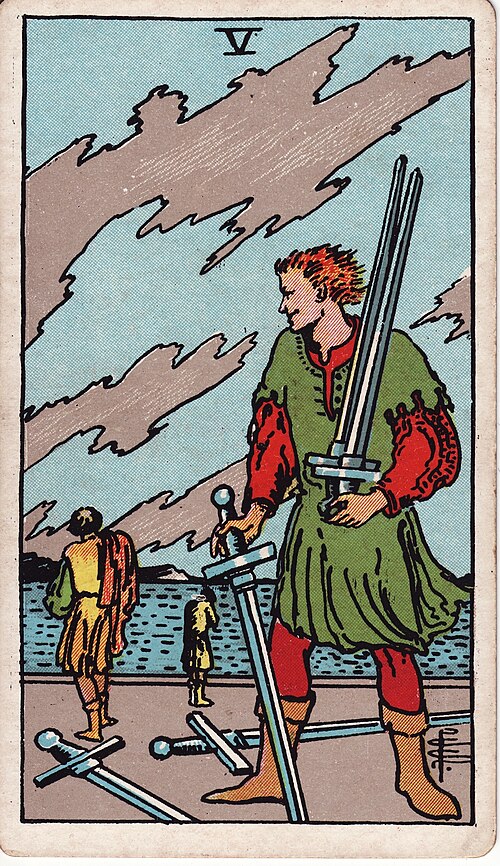
A figure with tousled red-gold hair dominates the foreground, glancing sideways with a thin, satisfied smile. He has gathered swords in his arms, while two more lie in the grass near the men walking away from him. Those two figures are small and turned toward the sea. Their shoulders slump, and one seems to hold his head low. The victory is complete, and so is the emptiness around it.
The sky is streaked with torn, windblown clouds in sickly yellows and grays, the kind of light that follows a storm or warns of one. The water looks choppy, and the shoreline is rugged. Nothing here is peaceful. The sword is the suit of the mind, so the scene suggests a fight carried out with words and pride more than force. The winner holds the weapons, and no one is left to share the field with him.
Five of Swords upright
Upright, the Five of Swords points to conflict where the stakes have become personal. There may be a dispute, a tense negotiation, or a quiet competition in which someone is keeping score. The card often shows up when winning has started to matter more than the outcome itself, when you're rehearsing comebacks in the shower or replaying a conversation to prove you were right. It can also describe being on the receiving end, feeling outmaneuvered, embarrassed or pushed to walk away.
In everyday life, it looks like the sarcastic last word, the group chat that turns sour, or the family disagreement where old grievances resurface. It's also a prompt to ask a few honest questions. Is this fight worth what it costs? Did you win the point and lose goodwill? Sometimes the wise move is to put the sword down, even if you could keep swinging.
Five of Swords reversed
Reversed, the card softens. The figures on the shore can turn around, the swords can be set down, and the story shifts toward reconciliation. You may be ready to apologize, to concede a point that no longer matters, or to ask for a truce. It can also mean the heat of a conflict is cooling and you're finally seeing the whole picture, including your own part in it.
There's a shadow side too. Reversed, the Five of Swords can show a fight that goes underground: resentment that isn't spoken, a grudge that's carried silently, or a hollow apology offered only to end the discomfort. It can also mean continuing a battle long after everyone else has moved on. Ask yourself whether you're really letting go or only pretending to.
Five of Swords in love
In love, the upright Five of Swords suggests an argument where each person is trying to be right instead of understood, or a dynamic where one partner wins and the other quietly withdraws. It may also point to a new connection strained by competitiveness or pride. Reversed, it favors repair: honest apologies, a cooling-off period that ends in conversation, or the courage to name your own part. It can also warn against bottled-up hurt that keeps a couple from truly reconciling.
Five of Swords in career
At work, upright, this card can point to office politics, turf disputes, credit-grabbing, or a negotiation where someone's ego is running the room. It invites you to ask whether a win would damage your reputation or your working relationships. Reversed, it suggests mending fences with a colleague, de-escalating a standoff, or stepping back from a feud that is draining your energy. It can also hint at lingering tension after a workplace disagreement that was never fully addressed.
Five of Swords and money
Around money, the Five of Swords is about attitudes more than numbers. Upright, it can reflect arguments over shared expenses, a competitive streak that turns finances into a scoreboard, or the temptation to win a dispute at any price. Reversed, it points to a calmer conversation about who pays for what, a willingness to compromise, or noticing a habit of spending to prove a point. Either way, it asks whether being right is worth the strain.
Five of Swords in a past, present or future position
Every spin of the Wheel of Fate draws three cards: your Past, Present and Future. Here's how Five of Swords reads in each place.
As your Past card
In the Past position, the Five of Swords suggests a conflict or defeat that still shapes how you approach disagreements. You may have won something at a cost, or lost something and quietly kept the sting. It invites you to consider what that episode taught you about pride, trust and walking away.
As your Present card
In the Present position, tension is active right now, and you may be tempted to push for the win. The card asks you to weigh what you'd gain against what you'd lose, and to notice whether you're defending a principle or just your pride. It's a moment to choose your battles consciously.
As your Future card
In the Future position, the Five of Swords points to a possible clash or a competitive situation ahead. It isn't fixed. It suggests you can prepare by deciding in advance what matters enough to fight for and what you'd rather let go. Staying aware of the cost of winning may change how things unfold.
Is Five of Swords a yes or no card?
Maybe. The Five of Swords leans toward a qualified answer. You might get what you want, but not without friction or cost. Before asking whether it's a yes, ask whether the outcome is worth the tension it may bring.
Advice from Five of Swords
Before your next argument, pause and name what you actually want. Is it a fair outcome, an apology, or simply to be seen as right? If it's the last, notice how the figure on the card stands alone with his swords. Consider letting a small point go, or saying one thing kindly that you'd usually say sharply. If you've already won a battle, look at who is walking away and ask whether a gesture of repair is possible. You don't have to give up your position to give up the fight.
Five of Swords FAQ
What does the Five of Swords mean in tarot?
The Five of Swords represents conflict, tension and winning at a cost. The card shows a smirking figure who has collected swords while two others walk away defeated. It asks you to consider whether a victory is worth the damage to relationships or your own peace of mind.
Is the Five of Swords a negative card?
It's a challenging card, but it isn't purely negative. It shows the cost of pride and hostility, which can be a useful warning. Its message is to choose your battles wisely, and it often points to an opportunity to de-escalate or make amends.
What does the Five of Swords reversed mean?
Reversed, the Five of Swords usually signals reconciliation, apologies or the end of a conflict. It can also point to lingering resentment or a grudge that hasn't been voiced. The card invites you to consider whether you're truly letting go or just suppressing the tension.