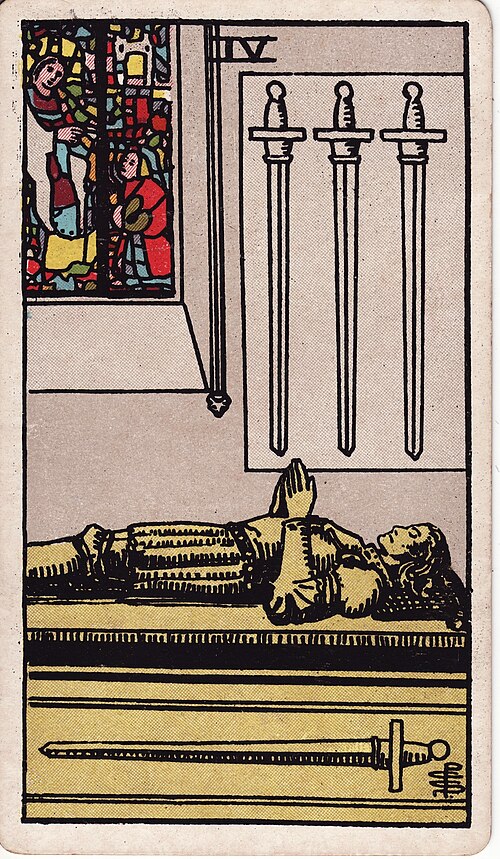
Four of Swords Tarot Card Meaning
The Four of Swords is the tarot's deliberate pause. After the tension and mental strain of the Swords cards that come before it, this card shows a figure who has stopped, lain down and gone quiet. It is not defeat or giving up. It is the kind of rest you choose on purpose, so your mind can settle and sort itself out. When it appears, the question is rarely what you should do next. It is usually what you need to stop doing for a while.
- Upright
- rest, recovery, contemplation
- Yes or no
- Maybe
- Element
- Air
What Four of Swords shows
Pamela Colman Smith places us inside a quiet church or chapel. A stone figure, dressed as a knight, lies flat on a slab with its hands pressed together in prayer. The pose is so still it looks carved, and that stillness is the point. Nothing is demanded of this figure, and nothing is happening to it. The card is about retreat, not about the end of anything, and it does not predict a literal death.
Three swords hang on the wall above the figure, points down, like tools put away for the day. The fourth lies beneath the slab, close at hand. That arrangement says a lot: your worries and arguments are within reach, but you are not holding them right now. In the stained-glass window, a kneeling figure faces a robed one, bathed in red, yellow and blue, a picture of comfort, guidance and care. The color is the only warmth in a muted room, hinting that a restful mind is not an empty one. It is a mind quietly receiving. The number four adds structure: four swords, four walls, a stable and enclosed space.
Four of Swords upright
Upright, the Four of Swords calls for rest that is real. That means actual recovery, not scrolling in bed while your thoughts race. It points to a stretch of time set aside after a hard season, a conflict, a deadline or a loss, when the most useful thing you can do is withdraw and let your system settle. It also carries the meaning of contemplation. Quiet is not only a break. It is where scattered thoughts finally line up and you can see what actually matters.
In daily life, this card might look like turning off notifications for a weekend, taking a sick day before you truly need one, meditating, praying, journaling or walking alone. It can also mean stepping back from an argument so that you can return with a clearer head. The card asks you to treat rest as part of the work, not a reward you earn only after everything is finished.
Four of Swords reversed
Reversed, the Four of Swords often describes rest that is refused, cut short or never really arrives. You may be pushing through exhaustion because slowing down feels like falling behind. The swords stay in your hands, so to speak, and your mind keeps rehearsing problems with no time to recover. Over time this can show up as irritability, poor focus, a short temper or a sense of running on fumes.
The reversal can also point to the opposite problem: a rest that has turned into avoidance. Retreat is helpful when it leads somewhere. If you have been hiding from a decision or a conversation for longer than you need to, the card may be nudging you to rise from the slab and rejoin the day. In either case, ask whether your current pace is something you chose or something you are just stuck in.
Four of Swords in love
Upright, this card suggests a relationship, or your approach to dating, benefits from calm. That could mean a breather after a rough patch, time alone to heal after a breakup, or a couple agreeing to cool off before returning to a difficult topic. Solitude is not a failure here. Reversed, it can indicate burnout from the emotional work of a relationship, or a refusal to give yourself space after a hurt. It may also show someone withdrawing so long that connection starts to fade. Ask whether you need quiet, or whether quiet has become a way to avoid being known.
Four of Swords in career
Upright, the Four of Swords favors recovery at work: a sabbatical, a lighter schedule, vacation time you actually use, or simply a pause to think before a big choice. It supports planning over action, especially after a stressful project. Reversed, it often flags overwork, ignored limits and the temptation to keep going when your judgment is getting dull. It can also describe a stall that has lasted too long, where you may be using rest as an excuse to avoid a decision. Notice what your energy is telling you about your workload and boundaries.
Four of Swords and money
In matters of money, this card points to attitudes and habits rather than outcomes. Upright, it encourages a calm, unhurried look at your finances. Pause before big choices, avoid decisions made in a rush or in a panic, and take time to understand where you stand. Reversed, it can reflect stress-driven spending, endless worry about money that stops you from planning, or avoiding your accounts altogether. Either way, the invitation is to approach money with a steady mind rather than a frantic one.
Four of Swords in a past, present or future position
Every spin of the Wheel of Fate draws three cards: your Past, Present and Future. Here's how Four of Swords reads in each place.
As your Past card
In the Past position, the Four of Swords suggests you recently went through a period of withdrawal, recovery or quiet thinking, or that you needed one and are still feeling the effects. That time of stillness may have shaped how you see things now. It can also hint that exhaustion from earlier events is still lingering.
As your Present card
In the Present position, this card says you are in, or should be in, a pause. Your mind and body may be asking for rest, and pushing forward could cost more than it gains. Take the stillness seriously rather than treating it as wasted time.
As your Future card
In the Future position, the Four of Swords suggests a restful or reflective phase may be ahead, or that building one in would serve you well. It points to the value of planning breaks before you reach the limit. It leaves open how you use that time, and what you decide when you rise again is up to you.
Is Four of Swords a yes or no card?
Maybe. The Four of Swords leans toward waiting rather than acting. It does not say no. It says not yet, and not while you are tired or overwhelmed. If your question is about rushing into something, the card suggests pausing. If it is about whether to rest, the answer is closer to yes.
Advice from Four of Swords
Treat this card as permission, and as a practical task. Decide what you can set down for a day, a week or an evening, and set it down: a task, an argument, a stream of messages. Choose a quiet place, even a small one, and give yourself time without a goal. Notice what your mind turns to when it is no longer being driven. When you feel steadier, pick up only one sword, the issue that most deserves your attention, and leave the rest hanging on the wall a little longer.
Four of Swords FAQ
What does the Four of Swords mean in tarot?
The Four of Swords represents rest, recovery and quiet contemplation. It shows a figure lying still in a chapel with swords set aside, suggesting a deliberate pause after stress. It encourages stepping back so your mind and body can recover and your thinking can become clear.
Is the Four of Swords a bad card?
No. Although the figure resembles a tomb effigy, the card is not about death or misfortune. It is about retreat and recovery. It can feel uncomfortable if you dislike slowing down, but it is generally a supportive card that points to healing and perspective.
What does the Four of Swords reversed mean?
Reversed, the Four of Swords usually points to restlessness, burnout or refusing to rest. You may be pushing through exhaustion, or your rest may have turned into avoidance. It asks whether you need to slow down, or whether it is time to emerge from retreat.