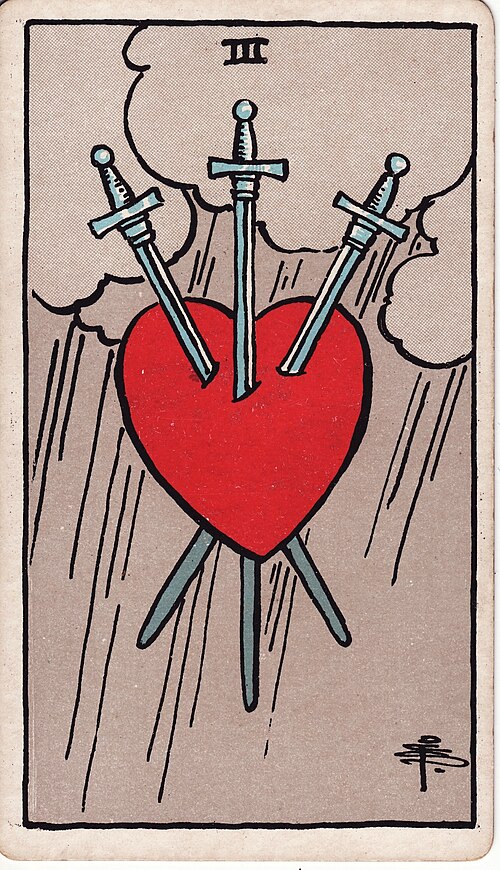
Three of Swords Tarot Card Meaning
The Three of Swords is the card people brace for, and it is also one of the most honest in the deck. It shows a heart pierced by three blades under a storm, and it names a hurt without dressing it up. Its themes are heartbreak, sorrow and painful truth: the moment a thing you hoped was fine turns out not to be, or a loss finally registers. The card does not say you are doomed to stay in that weather. It says the pain is real, and that you can't process what you won't look at.
- Upright
- heartbreak, sorrow, grief
- Yes or no
- No
- Element
- Air
What Three of Swords shows
Pamela Colman Smith's card has no people in it. A single large red heart floats in the center, run through by three straight swords with plain hilts, one blade vertical and two angled in on either side. Behind it hangs a heavy gray sky, and rain streams down across the whole image. The sparse, stripped-down design makes the card feel direct, almost like a diagram of a wound.
Swords belong to Air, the element of thought, speech and judgment, so this heart is hurt by words, realizations and conclusions as much as by events. A spoken sentence, a message you can't unread, or a conclusion you can't un-reach can all do it. The number three usually suggests something growing or taking shape. Here it points to a hurt that has become a fact: the blades are already in, and the storm is the process of letting the feeling move through. Red against gray also shows that the heart is still vivid and alive despite the sky.
Three of Swords upright
Upright, the Three of Swords describes sorrow that arrives with clarity. It might be a breakup, a betrayal, an estrangement, a disappointing answer, or a truth you had been avoiding. The key quality is that it is not vague unease. It has a specific edge, and part of the pain comes from finally seeing something plainly.
In daily life this can look like crying unexpectedly, replaying a conversation, or feeling raw around a person or place tied to a loss. It can also be quieter, such as the heaviness of finally admitting a plan, friendship or hope is over. The card asks you to feel it fully, name it accurately, and not rush to be fine. Naming exactly what hurts is often the first step toward doing something about it.
Three of Swords reversed
Reversed, the swords begin to loosen. The card points to recovery, forgiveness and the slow work of mending, though it doesn't promise a fast or tidy one. You might be past the sharpest shock and finding that you can talk about what happened without your voice breaking. It can also mean forgiving someone, or yourself, in a way that lets you put a weight down.
There is a shadow side, though. Reversed, the card can describe pain that is being held in, denied or replayed endlessly. That might mean grudges kept polished, grief postponed with busyness, or a story about the hurt retold until it hardens. If this is the version showing up, ask whether you are protecting yourself or just keeping the wound open. Support from people you trust, or from a qualified counselor if the weight feels too big, can help.
Three of Swords in love
Upright, the Three of Swords in love can point to a breakup, a betrayal of trust, a painful conversation or a hard recognition about a relationship. It can also mark a lonely stretch in which someone's absence is felt sharply. Whatever its form, it asks for honesty over pretending. Reversed, it suggests healing after a rupture: forgiveness being considered, distance giving perspective, or the first moments of feeling open again. It can also warn against clinging to old hurts so tightly that they color every new connection.
Three of Swords in career
At work, the upright card can describe a harsh piece of feedback, a disappointing decision, strained relationships with colleagues, or a realization that a role isn't what you hoped. It is a card of hard truths, and the honest ones may be useful even though they sting. Reversed, it suggests recovering from a setback, repairing a strained working relationship, or letting go of resentment about something that went badly. It can also hint that you are replaying a professional disappointment longer than it deserves.
Three of Swords and money
The Three of Swords says little about numbers, but it speaks to how we feel about money. Upright, it can reflect distress or regret tied to a money-related disagreement or decision, and the pain of facing an uncomfortable reality about your habits. The healthy response is to look clearly at what is true rather than avoid it. Reversed, it suggests easing tension around money, forgiving a past choice, and approaching your situation with calmer, steadier attitudes. It may also warn against letting an old financial regret shape every decision you make now.
Three of Swords in a past, present or future position
Every spin of the Wheel of Fate draws three cards: your Past, Present and Future. Here's how Three of Swords reads in each place.
As your Past card
In the Past position, the Three of Swords points to a hurt that still colors how you see things. It could be a loss, a betrayal or a truth that came out and changed you. Consider whether you have actually processed it, or merely moved past it.
As your Present card
In the Present position, the card says you are in or near a painful moment, and that acknowledging it matters more than being strong. Something is asking to be felt or said plainly. Be gentle with yourself and honest about what is hurting.
As your Future card
In the Future position, the card suggests a possible hard truth or emotional ache ahead, not a fixed fate. Take it as a prompt to be honest in your relationships and kind to yourself, which can soften the landing. What you do with the feeling remains your choice.
Is Three of Swords a yes or no card?
No. The Three of Swords leans toward No because it speaks of disappointment, loss and answers that hurt. The honest answer may not be the one you were hoping for. Reversed, it softens toward a Maybe, since healing or forgiveness may be on the table.
Advice from Three of Swords
Let the feeling be as large as it actually is. Write down, or say aloud to someone you trust, exactly what hurt and why. Precision helps more than drama, because a named sorrow is easier to carry than a shapeless one. Then ask which part is grief to be felt and which part is a story you keep repeating. Rest, ask for company, and do not demand an instant recovery of yourself. The rain in this card does not last forever, but it does need to fall.
Three of Swords FAQ
Is the Three of Swords a bad card?
It is a painful card, but not a bad one. It shows heartbreak or hard truth plainly so you can deal with it. Many readers see it as honest rather than cruel, since acknowledging sorrow is often the first step toward healing.
What does the Three of Swords mean in love?
In love, the Three of Swords upright points to heartbreak, betrayal, painful honesty or loneliness after a loss. Reversed, it suggests forgiveness and recovery, or a hurt held onto for too long. It highlights themes to reflect on and does not guarantee a particular outcome.
What does the Three of Swords reversed mean?
Reversed, the Three of Swords usually signals healing, forgiveness and slowly releasing pain. It can also warn of suppressed grief or resentment that is being replayed instead of resolved. Ask yourself which of those fits your situation.