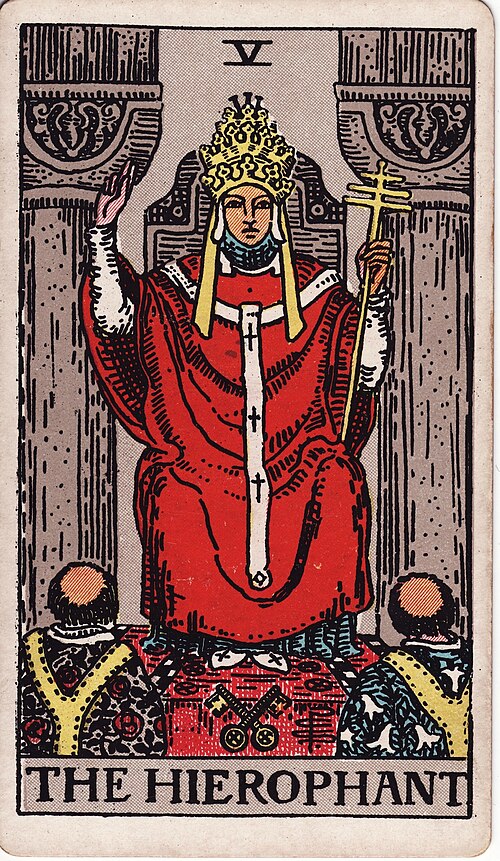
The Hierophant Tarot Card Meaning
The Hierophant is card number five of the Major Arcana, and it speaks for the things people hand down to one another: traditions, teachings, rituals and shared beliefs. Where the Empress and Emperor before it show natural abundance and personal authority, this card shows an institution, a lineage, a way of doing things that has outlasted any one person. It asks what you have inherited, what you still believe, and whether you need a teacher or a set of agreed rules right now.
- Upright
- tradition, guidance, belief
- Yes or no
- Maybe
- Number
- V
What The Hierophant shows
A robed figure sits between two thick gray pillars, wearing a three-tiered crown and red robes over blue. His right hand is raised in blessing, two fingers pointing up and two curled down, a gesture often read as a bridge between what is taught above and what is received below. In his left hand he holds a staff topped with a triple cross. The setting is a closed hall, not an open landscape, which tells you this card is about structure and shelter rather than adventure.
At his feet, two crossed keys, one gold and one silver, suggest access to knowledge that is not simply handed to everyone. Before him kneel two tonsured figures in white and gray. One robe is patterned with roses, the other with lilies, echoing the symbols of desire and thought found elsewhere in the deck. They have come to learn, not to argue. The number five, sitting between the stability of four and the upheaval of six, hints at a system that works because people choose to take part in it.
The Hierophant upright
Upright, the Hierophant points to guidance you can trust and customs that give life a shape. It can be a mentor, a school, a faith community, a professional body, a family tradition or simply a time-tested method. The card favors learning the established way properly before you try to improve on it, and it values belonging: the comfort of knowing what is expected and who stands with you.
In daily life this might look like signing up for a course, asking an experienced person how they would handle your problem, following a recipe or routine that has worked for generations, or marking a milestone with a ceremony. It can also point to your own conscience: the values you were raised with and chose to keep. The question to ask is whether the rules in front of you still serve the people they were made for.
The Hierophant reversed
Reversed, the Hierophant loosens the grip of convention. The kneeling figures stand up, the keys are yours to turn, and you begin to question whether a belief is truly yours or only familiar. This is the card of the person who has outgrown a script, who needs a different teacher, or who wants to build a ritual that fits their own life.
In practice it can show up as impatience with red tape, doubt about an old habit or group, or a decision to do something your family or field has never done. The caution is that rebellion for its own sake can leave you with no support. Reversed can also warn of rigid dogma, where someone insists on tradition simply because it is tradition. Ask what you want to keep before you decide what to discard.
The Hierophant in love
Upright, the Hierophant favors commitment that is openly acknowledged: shared values, meeting each other's families, rituals like anniversaries, or a relationship that grows through agreed expectations. It can suggest that traditional steps matter to you or your partner. Reversed, it points to relationships that do not follow the usual script, or to a feeling that expectations from others are crowding out what the two of you actually want. It invites an honest talk about what commitment means to each of you rather than what it is supposed to look like.
The Hierophant in career
Upright, this card suits structured environments: training programs, certifications, mentorship, established institutions and teams that value procedure. It often says that learning the craft the proper way will serve you better than shortcuts. Reversed, it hints at frustration with bureaucracy or a stale workplace culture, and perhaps an urge to freelance, change fields or challenge how things are done. Before breaking from the system, consider what you can borrow from it, and who might back your new approach.
The Hierophant and money
Where money is concerned, the Hierophant is about attitudes and habits, not particular results. Upright, it favors steady routines, respecting budgets and learning from people with more experience, while reflecting on the financial values you inherited. Reversed, it invites you to question money beliefs you absorbed without choosing them, or to notice when following the crowd is standing in for your own judgment. Either way, this card encourages learning the basics well and seeking qualified professionals for any specific financial decisions.
The Hierophant in a past, present or future position
Every spin of the Wheel of Fate draws three cards: your Past, Present and Future. Here's how The Hierophant reads in each place.
As your Past card
In the Past position, the Hierophant suggests that tradition, a mentor or an institution has shaped how you see things now. You may have learned the rules early, or been formed by a community whose values still echo in your choices.
As your Present card
In the Present position, you are in a season of learning, belonging or following a proven path. It may be wise to seek guidance, honor a commitment, or look closely at which beliefs are guiding your current decisions.
As your Future card
In the Future position, the card suggests that structure, mentorship or a shared set of values could become important. It may also point to a coming choice between joining an established way of doing things and carving your own, depending on how you respond.
Is The Hierophant a yes or no card?
Maybe. The Hierophant leans toward yes when your question involves commitment, learning or working within an established framework. It leans toward no when you are hoping for a quick, unconventional workaround. Because its answer depends on whether the rules truly fit you, it lands in the middle.
Advice from The Hierophant
Take an honest inventory of what you have been taught and what you still believe. Pick one tradition, habit or piece of advice worth keeping and say why, then pick one you are ready to question. If you need direction, find someone with real experience and ask a specific question rather than hoping for general wisdom. Whatever you choose, let it be a decision you have examined and made, not simply inherited.
The Hierophant FAQ
What does the Hierophant card mean in tarot?
The Hierophant represents tradition, spiritual or practical guidance, and shared values. It often points to mentors, institutions, rituals and the beliefs a community passes on. Its message is to learn from established wisdom while asking whether it fits your life.
What does the Hierophant mean reversed?
Reversed, the Hierophant suggests questioning rules, stepping away from convention, or choosing an unconventional path. It can also warn against rigid dogma or blindly following expectations. It invites you to decide which traditions you want to keep and which no longer serve you.
What do the crossed keys and kneeling figures on the Hierophant card symbolize?
The gold and silver crossed keys at the Hierophant's feet suggest access to knowledge that is passed on through teaching and trust. The two kneeling figures, robed with roses and lilies, represent students receiving that guidance. Together they show learning as a relationship between teacher and learner.